General The Anti-singleton Singleton

You heard it right. But I need your, help, feedback, cynicism, and emotional support.

The idea is having a singleton cube strewn with copy cards throughout. Half are labelled A, the other half are labelled B. Please don't give up on me here, the next paragraph ends it.

When you first draft a Copy A, you must imprint one of the cards in your pool. From then on, every Copy A you see will represent a copy of that imprinted card. The same applies to Copy B (allowing you to imprint a different card). Copy A and B for your opposition will represent whatever they imprinted instead.

This house rule suddenly allows non-singleton and parasitic cards to flourish while maintaining high card diversity.


The imprint mechanic is also costly - to turn your aether burst into 2 copies, you will have had to dedicate 3 draft picks. So it's up to you whether you go deep on A or B, both, or neither to just take good stuff/fixing.

Anyway, my mad scientist idea has been driving me nuts so I need your help on steering this bull.

Without further ado, here is the list so far:
https://cubecobra.com/cube/list/eb55b7d4-5338-4614-bff1-80afcc9926bf


Additional notes:
- I like the idea of non-synergistic cards present but think lightning bolt would be too oppressive.
- Risen Reef is probably the ceiling of bs
- We still want multiple copies of flame burst to feel good.
 
This sounds similar to the Duplicate Voucher system I've been running for a couple of years now.

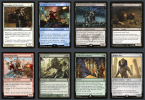
The original idea for me was inserting buildarounds and allowing vouchers that could be traded in for a copy of the given card (provided that you also drafted the single copy that exists in the cube). 2 ended up being the sweet spot for my cube and with my card choices, but it could be different depending on what you're going for. It's changed a lot over the years as I've identified core strategies and card interactions I wanted to maximize within my environment.

I've gone through many iterations testing different batches of cards, usually with an update every year or so, but this is what I'm currently on:

1787763224002.png

As long as you're up front with your drafters about the additional draft mechanic it should be pretty simple for them to grasp. The only thing I'd be worried about with your iteration is complexity overload if there are too many potential choices and combinations. It's a cool draft feature, but sometimes players opt in or out on the idea and just want to draft a cube like normal. It really comes down to what you think your playgroup with be fine with and how refined you want to get with your system.

I personally like the idea of duplicate vouchers as a clean solution so I threw in 4 copies of these as wildcard picks in the main cube:

MxwetGt.png


I go into more detail on the linked primer, but this system has worked very well over the last 5 years solving issues I had with "dead" duplicates for buildarounds in a draft pool and creating variable demand through a pod.
 
Last edited:
@shamizy thanks for sharing! Really cool idea and indeed a similar concept.

I guess the defining difference is in yours, the curator decides where the multiples are, while in mine, the drafters do.

I definitely think yours is a safer route by design. But I'm still committed to seeing if the ambitious level of liberty would be playable in my concept hahaha.
 
I implemented the simplest version of this in my cube. During deck building, choose two of your cards, get a second copy of each of them.
Nice! I tried that originally as well. What made me want to change it is that drafters got to choose the best card in their pool every time.

1. This basically turned any strong card to a two-of without strategic cost.
2. And reduced the variance of decks built.

I ultimately designed this "you gotta draft your copies and your choices are limited" system to incentivise experimentation through situation and creativity through restriction to combat those above points.

Do you experience the same thing? Or how did you avoid it?
 
Being reminded of the duplicate voucher system triggered some conversation between me and another cube player. We might be interested in trying that out, but it's also fun to think of expanding it to a pool bigger than the 8 or so cards in Shamizy's system. The Shamizy voucher is really simple and lightweight, so that has some immediate appeal. The rules are right there on the card that's drafted, and the only issue would be that the drafters might not all know what those cards do. But, with only four duplicate vouchers, they're easy enough to ignore for a new drafter.

I don't know that I would go straight to the described imprint system that lets a drafter have multiple copies of any card, but that's a really interesting take on things. The design of the particular cube would make all the difference. Power band outliers on the high end could be painful to play against, but quirky stuff in a more narrow power band would be interesting and offer quite a lot of variety. How many copy cards are you thinking of including in a draft as a portion of the total?

It's kind of like the Oathbreaker format with its signature spell, depending on how you run it. If the imprinted card was kept out of the deck and the opponent knows what card corresponds to Copy A and/or Copy B, then it's like a commander card you are likely but not guaranteed to draw, and you build your deck around it. That offers a lot of deck building possibilities if the cube design allows for it.
 
Both me and Japahn experimented with Twinning Cubes (each pick of a card gives you a duplicate). You can read about his cube here.

His process had a lot more insight into the benefits and drawbacks of the cube so I would recommend you read it.

I experimented with twinning because I had a homebrew Magic cube idea where I wanted to draft and play a game similar to Duel Masters / Kaijudo (every card can be played as a land). But found the process of drafting 60 cards to make 40 card decks to be a grueling experience with little benefit. So I instead went for three 11 or 12 card packs (never fully decided) and then each pick got you a twin duplicate. It created a similar experience to a slightly janky standard or modern deck, and it was quite fun.

The main reason that I abandoned the cube personally was because games very quickly told you which cards were the "strongest". Because the cube itself was singleton, players typically first picked and hate-drafted those strongest cards away. So, I felt like I didn't have the time to create such a curated environment, and while I like the gameplay of Duel Masters, my players were unfamiliar with it and it involved a lot of reading because each pick was incredibly important. So overall it never really became a fully complete cube.

I think if I restarted the cube again, I would just use the rules and cards from Duel Masters / Kaijudo rather than try to build my own homebrew rules, but I think that the twinning process of drafting would create a lot of good fun for it.
 
I think this a cool space, but never gave it a ton of thought myself. It did make me think of the companion cube where you companion a card you drafted and can therefore make it into a reliable build around. Not the same, but adjacent.
 
Top